

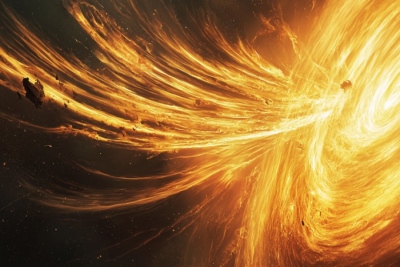
A coronal hole on the Sun could trigger a geomagnetic storm on Earth on September 24, reported the Solar Astronomy Laboratory of the Space Research Institute of the Russian Academy of Sciences and the Institute of Solar-Terrestrial Physics of the Siberian Branch of the Russian Academy of Sciences via Telegram. Scientists expect that Earth will face a large coronal hole and enter the high-speed stream of solar wind.
According to astronomers, the hole extends from the Sun's South Pole to its equator and could spark the second magnetic storm of this autumn season. At the same time, solar flare activity is expected to remain low over the coming days, with scientists rating general space weather conditions as relatively calm. It was previously reported that a strong magnetic storm was not expected on Earth on September 22. The probability of its occurrence was estimated at 3%, while the chance of a milder geomagnetic disturbance stood at 15% and a calm magnetic field at 82%. German scientists also studied archival data on sunspots and concluded that the Sun is capable of producing a superflare, the power of which could exceed that of all solar flares recorded over the past 70 years. Researchers also examined a giant sunspot observed in 1947 and found that its diameter was approximately 40 times larger than the diameter of Earth.
www.bankingnews.gr





Σχόλια αναγνωστών